Rainwater harvesting can help Vadodara homeowners collect, filter, store, or recharge rain that would otherwise flow into roads and drains. However, a successful system needs more than a storage tank or recharge pit. A well-designed rainwater harvesting filter removes leaves, dust, insects, roof debris, and other suspended material before the water enters a tank or groundwater recharge structure.
For most homes, the correct system includes roof gutters, a leaf screen, a first-flush device, a rainwater filter, safe piping, an overflow route, and either a covered storage tank or a properly designed recharge structure. The filter type and capacity should match the roof area, expected rainfall intensity, intended use, and available maintenance.
Vadodara homeowners should not assume that filtered rainwater is automatically safe for drinking. A basic rooftop filter improves physical quality, but it may not remove microorganisms, dissolved chemicals, or contamination from roofing materials. Water intended for drinking or cooking requires suitable treatment and periodic laboratory testing.
Rainwater harvesting is relevant to Vadodara because the city experiences heavy seasonal rainfall as well as local waterlogging and groundwater-recharge concerns. Vadodara Municipal Corporation has also promoted greater rainwater percolation in public works by shifting toward hollow paver blocks where possible.
The best rainwater filter is therefore not the most expensive unit. It is the one designed for your roof, water use, site layout, rainfall flow, and maintenance ability.
What Is a Rainwater Harvesting Filter?
A rainwater harvesting filter is a device that removes physical contaminants from collected rooftop rainwater before the water reaches a tank, recharge well, bore recharge point, or other collection structure.
Common contaminants include:
- Dry leaves
- Twigs
- Dust
- Bird droppings
- Insects
- Roof particles
- Sand and silt
- Organic debris
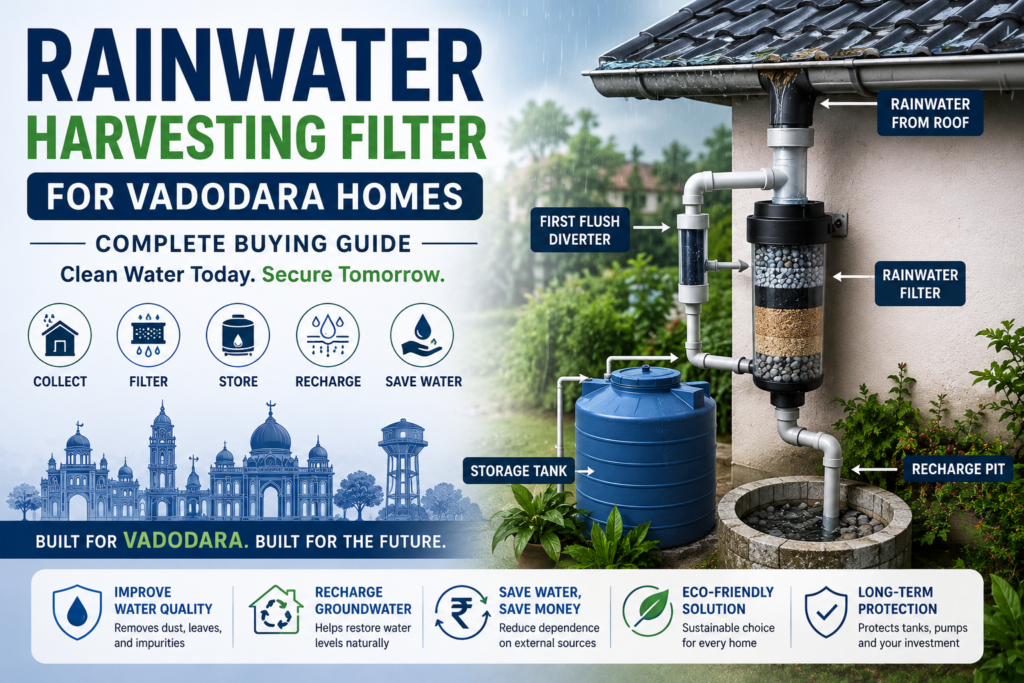
A filter usually works after the leaf screen and first-flush system. The first flush diverts the initial dirty rainwater that washes dust and pollutants from the roof. The remaining rainwater then passes through the main filter.
A complete system often follows this sequence:
Roof catchment → gutter → leaf screen → first flush → rainwater filter → storage or recharge
Each part has a separate purpose. Removing one part may reduce water quality or increase maintenance.
Why Do Vadodara Homes Need Rainwater Filtration?
Rain falling directly from the sky may appear clean, but rooftop runoff collects whatever is present on the roof.
During long dry periods, a roof may collect:
- Dust from roads and construction
- Leaves and pollen
- Bird and animal waste
- Airborne particles
- Paint or roofing residue
When the first rain arrives, these materials wash into the gutter. Sending this water directly into a tank can create odour, sediment, algae, and difficult cleaning work.
A proper filter helps:
- Reduce visible dirt and suspended matter
- Protect pumps and pipes from blockage
- Reduce sediment inside storage tanks
- Improve the quality of water entering recharge structures
- Make routine maintenance easier
- Reduce contamination caused by decomposing organic matter
Rainwater harvesting can also reduce runoff leaving a property. This matters in urban areas where concrete surfaces limit natural absorption. Vadodara has taken steps to improve percolation in public infrastructure because less permeable surfaces can contribute to groundwater-recharge loss and waterlogging.
How Does a Rainwater Filter System Work?
A well-designed system treats rainwater in stages.
1. Roof catchment
The roof acts as the collection surface. Its material, slope, cleanliness, and drainage layout affect water quality.
Smooth, non-toxic surfaces are generally easier to clean than rough or damaged roofs.
2. Gutters and downpipes
Gutters collect runoff and move it toward the filter. They should be correctly sloped and large enough to carry peak rainfall without overflowing.
3. Leaf screen
A screen blocks larger debris such as leaves, plastic, and twigs before it enters the downpipe.
4. First-flush diverter
The first flush captures or diverts the first dirty portion of rainfall. This initial water usually contains the highest level of roof dust and debris.
The required first-flush volume depends on roof size, local dust, roof material, and the time since the previous rainfall.
5. Main filter
The filter removes smaller suspended particles. Depending on the product, it may use:
- Stainless steel mesh
- Nylon screens
- Gravel
- Sand
- Charcoal
- Modular filter cartridges
- Vortex or self-cleaning mechanisms
6. Storage or recharge
Filtered water can move into a covered tank for reuse or into a suitable recharge structure.
The final destination determines how much treatment is required.
Which Type of Rainwater Filter Should You Choose?
Different filters suit different properties.
| Filter type | Best suited for | Main advantage | Main limitation |
| Mesh filter | Small homes and basic systems | Simple and affordable | Needs frequent cleaning |
| Sand and gravel filter | Recharge pits and larger flows | Uses common filtration media | Requires space and periodic media cleaning |
| Charcoal media filter | Systems needing added odour control | Helps reduce some colour and odour | Charcoal requires replacement |
| Modular rooftop filter | Villas and urban homes | Compact and easy to install | Must be sized correctly |
| Vortex or self-cleaning filter | Larger roofs and societies | Handles higher flow with less manual cleaning | Higher initial cost |
| Cartridge filter | Storage and reuse systems | Provides finer filtration | Cartridges may clog quickly |
No single filter is best for every Vadodara home.
A bungalow with a 100-square-metre roof may need a different unit from a housing society with several connected terraces. Ask the installer for the filter’s rated flow capacity rather than selecting only by pipe diameter.
How Do You Calculate Rainwater Harvesting Potential?
A simple estimate is:
Harvestable water = Roof area × rainfall × runoff coefficient
For example, suppose a home has:
- Roof area: 100 square metres
- Rainfall event: 50 millimetres, or 0.05 metre
- Runoff coefficient: 0.8
The estimated collection is:
100 × 0.05 × 0.8 = 4 cubic metres
That equals about 4,000 litres before subtracting first-flush diversion, overflow, leakage, and filtration losses.
The runoff coefficient accounts for water that does not reach the storage system. Smooth roofs often collect more effectively than rough or absorbent surfaces.
This calculation helps estimate potential volume, but the filter must also handle the flow rate during intense rain. A filter may have enough total capacity for a season but still overflow during a heavy downpour if its hourly flow rating is too low.
What Size Filter Does Your Home Need?
Filter selection should consider:
- Total connected roof area
- Number and size of downpipes
- Local rainfall intensity
- Roof slope
- Intended water use
- Storage or recharge capacity
- Available maintenance access
Do not size a filter only by the number of family members. Family size affects water demand, but roof size and rainfall determine how much water enters the filter.
For a small independent home, one correctly sized filter may be enough. Larger villas may require multiple collection zones. Apartment societies may need several filters, inspection chambers, or a central high-flow filtration arrangement.
An experienced installer should check whether the system can safely bypass excess flow during very heavy rain.
Should You Store Rainwater or Use It for Recharge?
Both options can be useful, but they serve different goals.
Storage system
A storage tank allows water to be reused for:
- Gardening
- Floor cleaning
- Vehicle washing
- Toilet flushing
- Outdoor cleaning
- Other suitable non-drinking uses
Storage systems require covered tanks, overflow protection, mosquito control, tank-cleaning access, and suitable pumps.
Groundwater recharge system
A recharge system directs filtered rainwater into the soil through a recharge pit, trench, shaft, or well.
It may suit properties with limited storage space or high groundwater-recharge potential. However, recharge design should consider soil, geology, groundwater level, existing borewells, and contamination risk.
Do not send dirty rooftop runoff directly into a borewell. Poorly designed recharge can transfer contamination underground.
A qualified professional should inspect the site before connecting rainwater to any groundwater structure.
Can Filtered Rainwater Be Used for Drinking?
A basic rainwater harvesting filter does not automatically make water safe for drinking.
Mesh, sand, gravel, and modular filters mainly remove physical matter. They may not reliably remove:
- Bacteria
- Viruses
- Dissolved metals
- Chemicals
- Pesticide residue
- Contamination from roofing materials
Water intended for drinking requires additional treatment based on laboratory results. This may include fine filtration, activated carbon, UV disinfection, ultrafiltration, RO, or another suitable process.
The World Health Organization notes that safe drinking water requires protection from microbial and chemical risks. Appearance alone cannot confirm safety.
Use untreated or simply filtered rainwater only for appropriate non-potable applications unless testing and treatment confirm that it is fit for consumption.
What Features Should Buyers Compare?
Flow capacity
The filter must handle the expected peak flow from the connected roof.
Filter material
Choose corrosion-resistant, washable, and durable materials suitable for outdoor use.
First-flush compatibility
A filter should work with a proper first-flush device rather than replacing it.
Cleaning access
The filter should be easy to open, inspect, and wash. A filter that is difficult to reach is more likely to be neglected.
Bypass and overflow
Excess rainwater needs a safe path away from the foundation. The system should not cause terrace flooding or pipe pressure.
Mosquito protection
All openings, vents, and overflows should include suitable screening.
Replacement availability
Check whether mesh, seals, cartridges, and filter media are locally available.
Warranty and service
Ask what the warranty covers and whether cleaning, installation correction, and replacement parts are included.
How Much Does a Rainwater Filter Cost?
The total cost depends on more than the filter unit.
Important cost factors include:
- Roof area
- Number of downpipes
- Filter technology
- Pipe changes
- First-flush arrangement
- Tank size
- Recharge-pit construction
- Pump requirements
- Civil work
- Site accessibility
- Maintenance needs
A compact filter attached to one downpipe will usually cost less than a complete society-level harvesting system.
Avoid selecting a product based on the lowest quotation alone. Compare the full scope:
| Cost item | Questions to ask |
| Filter | Is its flow capacity suitable for the roof? |
| Pipes | Are new gutters or downpipes included? |
| First flush | Is a proper diverter included? |
| Storage | Is the tank covered and mosquito-proof? |
| Recharge | Are soil and site conditions considered? |
| Installation | Does the price include testing and leak checks? |
| Service | Who cleans or repairs the system? |
Request a written quotation that lists every component.
What Maintenance Does the System Need?
Rainwater harvesting is not maintenance-free.
Before the monsoon
- Clean the roof.
- Remove leaves from gutters.
- Check downpipe joints.
- Clean the first-flush chamber.
- Wash or replace filter media.
- Inspect tank covers and screens.
- Check overflow routes.
- Test pumps and valves.
During the monsoon
- Inspect the system after heavy storms.
- Remove collected debris.
- Check for overflow or leakage.
- Confirm that the first-flush device resets correctly.
- Watch for slow flow through the filter.
After the monsoon
- Clean the filter.
- Remove sediment from accessible chambers.
- Inspect the storage tank.
- Check pipes for damage.
- Record any repairs needed before the next season.
A clogged filter can cause roof overflow, gutter leakage, stagnant water, and reduced collection.
What Mistakes Should Vadodara Homeowners Avoid?
Skipping the first flush
The filter should not receive the dirtiest initial runoff without diversion.
Choosing an undersized filter
A small filter may work in light rain but overflow during a strong storm.
Leaving the tank open
Open tanks invite mosquitoes, dust, algae, and accidental contamination.
Connecting every roof surface
Avoid collecting water from surfaces with unsafe coatings, chemical residue, or frequent animal contamination unless a professional confirms suitability.
Ignoring the overflow route
An overflowing tank can damage walls, foundations, landscaping, or neighbouring property.
Assuming recharge is always safe
Recharge must suit local soil and groundwater conditions. It should not introduce contaminated water underground.
Forgetting maintenance access
Install filters and first-flush chambers where they can be safely reached and cleaned.
Who Should Install a Rainwater Harvesting System?
Choose a provider who can inspect the property and explain:
- Roof collection area
- Expected water volume
- Filter flow rating
- First-flush design
- Storage or recharge recommendation
- Overflow management
- Maintenance schedule
- Water-use limitations
For structural changes, large tanks, borewell recharge, or apartment projects, consult relevant engineers or qualified professionals. Property owners should also confirm current requirements with Vadodara Municipal Corporation or the appropriate development authority before construction.
Frequently Asked Questions
How often should a rainwater filter be cleaned?
Clean it before the monsoon and inspect it after heavy rainfall. Homes near trees, roads, or construction sites may need more frequent cleaning.
Is a first-flush device necessary?
Yes. It diverts the initial dirty roof runoff and reduces the load on the main filter and storage tank.
Can a rainwater filter connect directly to a borewell?
Direct connection is not recommended without proper design and site assessment. Filtered water may still carry contamination that can affect groundwater.
Which filter is best for a small Vadodara home?
A compact modular or mesh-based filter may work for a small roof, provided its flow rating matches the roof area and rainfall intensity.
Can rainwater be used for bathing?
It may be used after suitable treatment and testing. Basic rooftop filtration alone may not provide the quality needed for personal use.
Does rainwater harvesting reduce water bills?
It can reduce demand for mains or tanker water when collected water replaces suitable non-drinking uses. Savings depend on rainfall, storage, consumption, and system cost.
Conclusion
A good rainwater harvesting filter protects storage tanks, recharge structures, pipes, and pumps by removing roof debris before it enters the system. Vadodara homeowners should choose a filter based on roof area, rainfall flow, intended water use, available space, and maintenance needs. A complete system should include roof cleaning, leaf protection, first-flush diversion, suitable filtration, safe overflow, and covered storage or professionally designed recharge.
Before installation, request a site assessment and confirm what the collected water can safely be used for. Aqua Tatva can help homeowners in Vadodara review their property requirements and choose a practical rainwater filtration solution with suitable installation and service support.