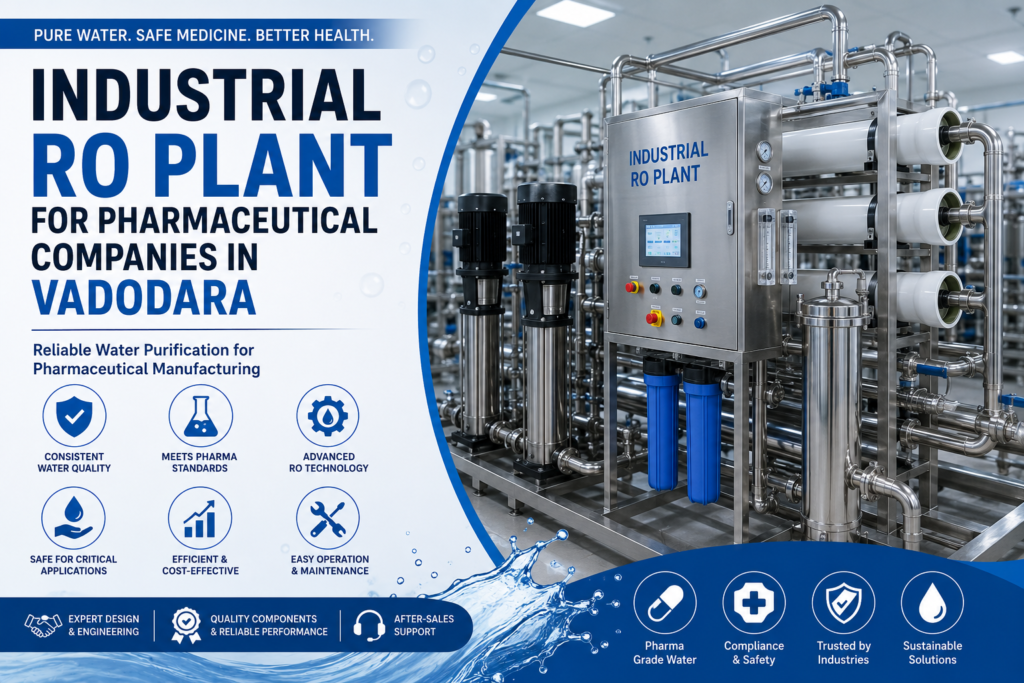
An industrial RO plant for pharmaceutical companies in Vadodara must do more than reduce TDS. It must form part of a controlled pharmaceutical water system designed around the product, process, feed-water quality, required water grade, microbiological risk, storage, distribution, monitoring, and regulatory expectations.
Reverse Osmosis, commonly called RO, is often used as a key purification stage for generating pharmaceutical process water. However, an RO skid alone does not automatically produce compliant Purified Water or Water for Injection. A complete system may require pretreatment, double-pass RO, ultraviolet treatment, ultrafiltration, electrodeionization, sanitisation, hygienic storage, a recirculating distribution loop, online instruments, sampling points, and documented validation.
The correct design depends on how the water will be used. Water for equipment washing, oral formulations, active pharmaceutical ingredients, laboratories, sterile products, and injectable manufacturing may require different quality controls. Pharmaceutical companies should define the required water grade before selecting plant capacity or technology.
WHO guidance treats pharmaceutical water as a critical utility that must be properly designed, installed, qualified, operated, monitored, and maintained. Water systems must remain under chemical and microbiological control throughout their lifecycle, not only when the plant is commissioned.
For Vadodara pharmaceutical manufacturers, the safest approach is to begin with a detailed user requirement specification, feed-water analysis, process-use review, and risk assessment. The plant should then be designed with input from engineering, production, quality assurance, microbiology, validation, and regulatory teams.
Why Is Water Critical in Pharmaceutical Manufacturing?
Water is one of the most widely used materials in pharmaceutical facilities. It may serve as:
- A product ingredient
- A formulation solvent
- A cleaning agent
- A rinsing medium
- Laboratory water
- Feed water for clean steam
- Process water for intermediates
- Utility water for equipment and systems
Its quality can affect product identity, strength, purity, stability, and microbial safety.
A water system may pass chemical testing yet still carry microbial risk. Bacteria can grow inside storage tanks, dead legs, poorly drained pipes, damaged membranes, low-flow areas, or systems that remain stagnant.
For this reason, pharmaceutical water systems require ongoing monitoring rather than occasional testing. Purified water used in pharmaceutical production must remain within microbiological control and be tested regularly.
What Is an Industrial RO Plant?
An industrial RO plant uses pressure to move pretreated water through a semi-permeable membrane. The membrane separates part of the dissolved salts, organic matter, microorganisms, and other contaminants from the treated-water stream.
The system produces two flows:
- Permeate: Water that passes through the membrane
- Reject or concentrate: Water containing a higher concentration of retained contaminants
RO performance depends on:
- Feed-water quality
- Temperature
- Operating pressure
- Membrane condition
- Recovery rate
- Pretreatment
- Scaling potential
- Fouling risk
- Cleaning practices
An industrial RO plant should not be selected only by litres per hour. The water-quality objective, system recovery, sanitisation approach, monitoring requirements, and distribution design are equally important.
Which Water Grades Do Pharmaceutical Companies Need?
The required grade depends on the intended pharmaceutical use and the applicable pharmacopoeia, licence conditions, product dossier, and regulatory requirements.
Potable water
Potable water may be used as feed water for further purification and for selected non-product-contact purposes. It must meet applicable drinking-water requirements.
Purified Water
Purified Water is widely used in non-sterile manufacturing, equipment cleaning, formulation, and other approved applications. The exact use depends on the product and process.
Water for Injection
Water for Injection, commonly called WFI, is required for specified sterile and parenteral applications. It has tighter microbiological and endotoxin controls than standard Purified Water.
Manufacturers should never assume that RO water and pharmaceutical Purified Water are interchangeable terms. RO describes a technology. Purified Water describes a quality grade that must meet defined specifications.
Where Does RO Fit in a Pharmaceutical Water System?
A typical system may include the following stages:
| Treatment stage | Main purpose |
| Raw-water tank | Provides stable feed supply |
| Multimedia filter | Reduces suspended solids and turbidity |
| Activated carbon filter | Reduces chlorine and selected organic matter |
| Water softener or antiscalant | Controls hardness and membrane scaling |
| Micron filtration | Protects RO membranes from particles |
| First-pass RO | Reduces dissolved salts and contaminants |
| Second-pass RO | Provides further ionic reduction and consistency |
| UV system | Supports microbial or organic control |
| EDI | Provides continuous deionisation where required |
| Final filtration | Controls fine particles in selected applications |
| Purified-water tank | Provides hygienic storage |
| Distribution loop | Delivers water to points of use |
The final arrangement depends on the feed water and target quality. Not every facility requires every stage.
Why Is Pretreatment Important?
Pretreatment protects the RO membrane and helps maintain stable performance.
Untreated feed water may contain:
- Hardness
- Chlorine
- Iron
- Silica
- Suspended solids
- Organic matter
- Microorganisms
- Colloidal material
Chlorine can damage some membrane materials. Hardness and silica can create scale. Suspended matter can block membrane channels. Organic contamination can encourage biofouling.
Poor pretreatment can lead to:
- Reduced permeate flow
- Higher differential pressure
- Increased conductivity
- Frequent chemical cleaning
- Short membrane life
- Unplanned shutdowns
- Inconsistent water quality
A detailed raw-water test should be completed before design. Seasonal changes and changes between municipal, borewell, or tanker water should also be considered.
How Should Pharmaceutical Companies Choose Plant Capacity?
Capacity should be based on actual and future demand, not a rough estimate.
Calculate:
- Production consumption
- Cleaning and rinsing demand
- Laboratory usage
- Peak hourly requirement
- Sanitisation demand
- Distribution-loop return
- Planned expansion
- Maintenance downtime
- Storage-tank capacity
- Expected system recovery
Suppose a facility needs 20,000 litres of purified water daily. The plant should not automatically be sized by dividing that figure by operating hours. Engineers should also consider peak demand, tank refill time, membrane cleaning, sanitisation, and reserve capacity.
A plant that is too small may run continuously and fail to recover after peak demand. An oversized plant may cycle frequently or create long periods of stagnation.
What Should Be Included in a User Requirement Specification?
The User Requirement Specification, or URS, defines what the water system must achieve.
It should include:
- Required water grade
- Applicable pharmacopoeia
- Feed-water quality
- Required production capacity
- Peak and daily demand
- Chemical-quality limits
- Microbial-quality expectations
- Endotoxin requirements where applicable
- Storage volume
- Distribution-loop requirements
- Sanitisation method
- Construction materials
- Instrumentation
- Automation
- Alarm limits
- Data recording
- Sampling points
- Documentation
- Qualification requirements
- Maintenance access
The URS should be approved before equipment selection. Buying a standard commercial RO skid first and defining requirements later can create costly compliance gaps.
Which Materials Are Suitable for Pharmaceutical RO Systems?
Material selection depends on system stage and required water quality.
Pretreatment systems may use suitable engineering plastics, coated vessels, FRP, or stainless steel. Product-contact sections after final purification often require hygienic stainless-steel construction.
Common considerations include:
- Corrosion resistance
- Surface finish
- Drainability
- Cleanability
- Sanitisation compatibility
- Welding quality
- Elastomer compatibility
- Documentation and traceability
For hygienic loops, poor welds, rough surfaces, threaded joints, and dead legs can create microbial harbourage points.
Material certificates, welding records, passivation documents, and inspection reports may be required as part of the qualification package.
Why Are Storage and Distribution as Important as RO?
A well-performing RO plant can still feed a poorly designed distribution system.
Purified water may become contaminated after production due to:
- Stagnant storage
- Inadequate tank vent filtration
- Dead legs
- Low loop velocity
- Poor drainage
- Infrequent sanitisation
- Unsuitable gaskets
- Contaminated sample valves
- Improper maintenance
The storage and distribution system should be designed to keep water moving and minimise microbial growth.
Important features may include:
- Hygienic tank design
- Spray ball
- Filtered vent
- Sloped pipework
- Continuous recirculation
- Sanitary sample valves
- Controlled temperature
- Sanitisation provisions
- Minimal dead legs
- Return-loop monitoring
Quality cannot be maintained by the RO membrane alone.
Which Parameters Should Be Monitored?
Monitoring should combine online instruments, laboratory testing, trend analysis, and routine inspection.
| Parameter | Why it matters |
| Conductivity | Indicates ionic contamination and purification performance |
| Total Organic Carbon | Indicates organic contamination where required |
| Pressure | Helps assess filters, membranes, and pump performance |
| Flow rate | Confirms production and distribution performance |
| Differential pressure | Helps identify fouling or blockage |
| Temperature | Affects RO output and microbial risk |
| Microbial count | Shows microbiological control |
| Endotoxin | Required for applicable high-purity water uses |
| Tank level | Supports production planning and alarm control |
| pH | Useful for process review and troubleshooting |
Alarm and action limits should be justified and documented. Trend analysis often reveals deterioration before a result exceeds specification.
What Is Pharmaceutical Water-System Validation?
Validation provides documented evidence that the system consistently performs as intended.
A lifecycle approach usually includes:
Design Qualification
Confirms that the proposed design meets the approved requirements.
Installation Qualification
Confirms that equipment, instruments, materials, piping, components, and documentation match the approved design.
Operational Qualification
Tests functions, alarms, controls, operating ranges, sanitisation cycles, and critical operating conditions.
Performance Qualification
Demonstrates consistent water quality under routine operating conditions over an appropriate period.
Validation is not complete after one passing sample. It should evaluate chemical quality, microbial trends, seasonal variation, operating conditions, sanitisation, and all representative points of use.
How Should the System Be Sanitised?
Sanitisation controls microbial growth within the system.
Common methods include:
- Hot-water sanitisation
- Steam sanitisation
- Ozone
- Chemical sanitisation
- UV support
The correct method depends on materials, system design, water grade, temperature limits, and operational risk.
A chemical sanitisation process must control:
- Concentration
- Contact time
- Coverage
- Rinsing
- Residue removal
- Operator safety
- Documentation
Sanitisation cannot correct a fundamentally poor design. Dead legs and stagnant areas may remain difficult to sanitise even when strong chemicals are used.
What Maintenance Does an Industrial RO Plant Need?
A preventive-maintenance programme should cover the entire system.
Typical activities include:
- Checking raw-water quality
- Replacing cartridge filters
- Monitoring pressure drop
- Inspecting dosing systems
- Calibrating instruments
- Reviewing membrane salt rejection
- Cleaning RO membranes
- Inspecting UV lamps
- Checking tank vent filters
- Sanitising tanks and loops
- Inspecting pumps and seals
- Reviewing microbial trends
- Verifying alarm functions
- Maintaining spare parts
Maintenance work must follow approved procedures. After major interventions, the system may need sanitisation, testing, or partial requalification before returning to service.
What Common Mistakes Should Companies Avoid?
Choosing only by price
A low-cost system may lack hygienic design, documentation, automation, or service support.
Treating RO as the full system
RO is one stage. Storage, distribution, monitoring, sanitisation, and validation are equally important.
Ignoring seasonal feed-water variation
Borewell and municipal water quality may change, affecting membrane performance and pretreatment needs.
Using too many dead legs
Poorly designed branches can allow stagnant water and microbial growth.
Delaying membrane cleaning
Waiting until output falls sharply may lead to irreversible fouling.
Focusing only on conductivity
Low conductivity does not prove microbiological control.
Accepting incomplete documentation
Missing drawings, material certificates, calibration records, software details, or welding records can delay qualification.
How Should Companies Evaluate an RO Plant Manufacturer?
Ask potential suppliers to provide:
- Relevant pharmaceutical-project experience
- Water analysis and design calculations
- Detailed process-flow diagram
- Piping and instrumentation diagram
- Material specifications
- Membrane calculations
- Recovery and reject-water estimates
- Instrument list
- Automation details
- Sanitisation strategy
- Documentation index
- Qualification support
- Calibration support
- Service response plan
- Spare-parts availability
- Training plan
The final design should be reviewed by the pharmaceutical company’s own engineering and quality teams. Regulatory responsibility remains with the manufacturer using the water system.
Frequently Asked Questions
Is RO water suitable for pharmaceutical manufacturing?
RO may be used as a major purification stage, but the final water must meet the required pharmaceutical specification. Additional treatment, hygienic storage, distribution, monitoring, and validation may be necessary.
What is double-pass RO?
Double-pass RO sends first-pass permeate through a second RO stage. This provides further reduction of dissolved ions and can improve consistency.
Can an RO plant produce Water for Injection?
RO may form part of a WFI generation system where permitted by the applicable pharmacopoeia and regulatory framework. The complete validated system must meet all chemical, microbial, and endotoxin requirements.
How often should pharmaceutical RO membranes be cleaned?
Cleaning frequency depends on pressure, flow, salt rejection, fouling trends, and feed-water conditions. Cleaning should follow validated criteria rather than a fixed calendar alone.
Why is a recirculation loop required?
Continuous recirculation helps reduce stagnation and maintain consistent water quality across the distribution system.
What is the difference between industrial RO water and Purified Water?
Industrial RO water is water treated by RO technology. Purified Water is a defined pharmaceutical grade that must meet applicable compendial and internal specifications.
Conclusion
An industrial RO plant for a pharmaceutical facility must be designed as part of a complete, controlled water system. Companies should define the required water grade, study feed-water quality, calculate realistic demand, choose suitable pretreatment, control storage and distribution, establish online monitoring, and complete documented qualification.
Before approving a supplier, pharmaceutical companies should review technical capability, hygienic design experience, validation support, documentation quality, service capacity, and regulatory understanding. For manufacturers seeking a requirement-based industrial RO plant in Vadodara, Aqua Tatva can support system planning, equipment selection, installation coordination, and ongoing service based on the site’s water source, capacity, and process needs.