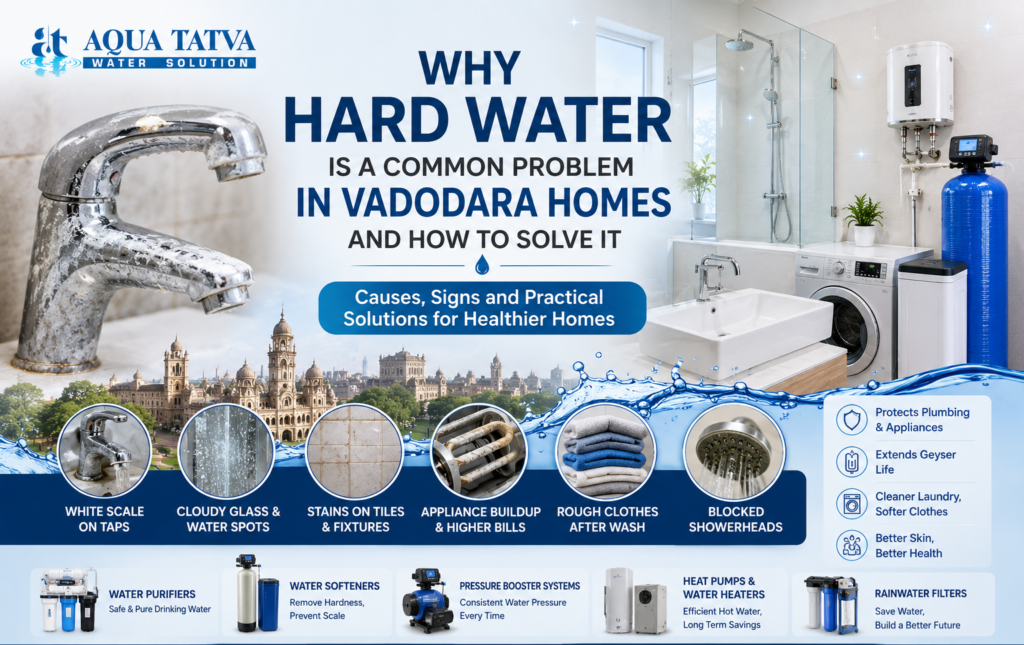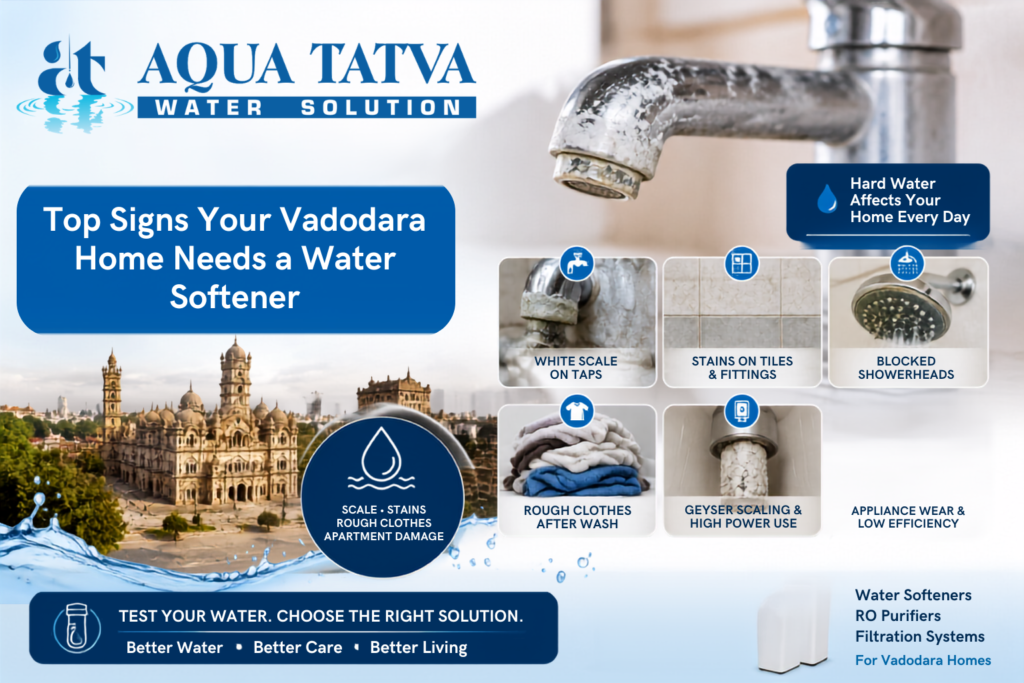
Vadodara homeowners may need a water softener if they see white scale on taps, dull bathroom tiles, soap that does not lather well, rough clothes after washing, dry skin after bathing, or frequent problems in geysers, washing machines, and plumbing fixtures. These signs often point to hard water, which contains higher levels of dissolved minerals such as calcium and magnesium.
If you are searching for a water softener in Vadodara, the first step is not to buy a system quickly. The smarter step is to understand your water source, test hardness levels, and check how hard water is affecting your home. Many homes in Vadodara use municipal water, borewell water, tanker water, or a mix of sources. Each source can have different hardness, TDS, taste, and scaling behaviour.
Hard water is not always unsafe to drink on its own. The World Health Organization notes that hardness is mainly linked to calcium and magnesium in water. However, hard water can create daily problems inside the home. It can leave deposits on fixtures, reduce soap performance, affect bathroom cleanliness, and shorten the working life of water-using appliances.
A water softener helps reduce hardness before water reaches bathrooms, kitchens, washing machines, geysers, and pipelines. For many homes, bungalows, flats, and residential societies in Vadodara, this can improve comfort and reduce maintenance headaches.
What Is Hard Water?
Hard water is water that contains higher amounts of dissolved minerals, mainly calcium and magnesium. These minerals enter water naturally as it passes through soil, rocks, underground layers, or certain water distribution systems.
In simple terms, hard water is the reason your tap may look white and chalky even after cleaning. It is also why soap may feel sticky on your skin rather than rinse clean.
Hardness is usually measured as milligrams per litre (mg/L) as calcium carbonate. A water test can tell you whether your water is soft, moderately hard, hard, or very hard.
| Hardness Level | Approximate Range | What It Means for Homes |
| Soft water | 0 to 60 mg/L | Usually, fewer scale issues |
| Moderately hard water | 61 to 120 mg/L | Some soap and cleaning issues may appear |
| Hard water | 121 to 180 mg/L | Scale, stains, and appliance stress become more common |
| Very hard water | Above 180 mg/L | Strong chance of visible deposits and maintenance issues |
This range is widely used for general understanding, but your final decision should depend on a proper water test and site conditions.
Why Is Hard Water Common in Vadodara Homes?
Vadodara has different types of residential areas, including flats, bungalows, old houses, new societies, and developing zones. Water quality can vary across Gotri, Bhayli, Vasna Road, Makarand Desai Road, and nearby areas because homes may draw water from different sources.
Common sources include:
- Municipal water
- Borewell water
- Tanker water
- Mixed water supply
- Society-level storage tanks
- Independent underground or overhead tanks
Borewell and tanker water may show higher mineral content in many cases. Even municipal water can create hardness-related issues depending on the source, storage, and pipeline condition. That is why two homes in the same city may face different water problems.
1. White Scale on Taps, Showerheads, and Bathroom Fittings
One of the clearest signs of hard water is white or chalky scale on taps, showerheads, faucets, and bathroom fittings. This scale forms when hard water dries, leaving mineral deposits behind.
You may notice:
- White marks around tap edges
- Blocked shower holes
- Dull chrome fittings
- Crusty deposits near geyser outlets
- Frequent need to scrub bathroom fixtures
If the marks return quickly after cleaning, the issue is likely not your cleaning method. It may be the water itself.
2. Soap and Shampoo Do Not Lather Properly
Hard water reacts with soap, reducing the amount of foam. This means you may need to use more soap, shampoo, body wash, or detergent to achieve the same cleaning effect.
Common signs include:
- Soap feels sticky on the skin
- Shampoo does not foam well
- Hair feels heavy after washing
- More detergent is needed for laundry
- Bathroom floors feel slippery after bathing
This happens because minerals in hard water reduce the cleaning action of soaps and detergents. Over time, this increases product usage and daily frustration.
3. Clothes Feel Rough, Dull, or Stiff After Washing
If your clothes feel rough even after using detergent and fabric conditioner, hard water may be the reason. Minerals can become trapped in fabric fibres, making clothes feel stiff.
You may notice:
- White clothes becoming dull
- Dark clothes are losing their brightness
- Towels feeling rough
- Bedsheets feel less soft
- Detergent residue on clothes
This problem is common in homes where washing machines use untreated hard water. A water softener can help improve wash quality by reducing water hardness before it enters the machine.
4. Dry Skin and Rough Hair After Bathing
Hard water can leave mineral residue on skin and hair. Some people may feel dryness, itchiness, or roughness after bathing. Hair may feel dull, frizzy, or difficult to manage.
This does not mean hard water affects everyone the same way. Skin type, hair type, bathing products, and water temperature also matter. Still, if several family members notice dryness after shifting to a new home or changing the water source, hardness testing is a practical next step.
Helpful tip: If changes to moisturiser, shampoo, or soap do not help much, test the water hardness instead of only changing personal care products.
5. Geysers and Water Heaters Need Frequent Maintenance
Geysers and water heaters are strongly affected by hard water because heating speeds up scale formation. Minerals can settle inside the tank, on heating elements, and around outlets.
Watch for these signs:
- A geyser takes longer to heat water
- Hot water flow becomes weaker
- Strange popping or crackling sounds
- Higher electricity use
- Frequent service calls
- Reduced heating performance
Scale acts like a barrier between the heating element and water. This can make the heater work harder and reduce efficiency. For homes with multiple bathrooms, this can become a costly long-term issue.
6. Washing Machine and Dishwasher Problems Increase
Hard water can affect appliances that use water every day. Washing machines, dishwashers, coffee machines, and steam appliances can collect scale inside pipes, valves, drums, and heating parts.
Possible warning signs include:
- White deposits inside the washing machine drum
- Detergent not dissolving properly
- Dishes or glasses looking cloudy
- Longer wash cycles
- Appliance error messages
- More frequent repairs
If your appliances are new but still underperforming, check the water quality before blaming the machine.
7. Bathroom Tiles and Glass Partitions Look Cloudy
Hard water often leaves stains on glass partitions, tiles, buckets, mugs, and bathroom walls. These marks can look white, grey, or cloudy.
You may clean the bathroom regularly, but the stains return after a few showers. This is a strong sign of dissolved minerals drying on surfaces.
Hard water stains are usually harder to remove than normal dirt. Acidic cleaners may temporarily remove them, but they will return unless the water is treated.
8. Water Pressure Drops Over Time
Hard water can create scale inside pipes and fixtures. Over time, this buildup may narrow the water passage and reduce flow.
You may notice:
- Slow shower flow
- Weak tap pressure
- Uneven water pressure between bathrooms
- Reduced hot water flow
- Blocked showerheads
- More plumbing complaints in society buildings
Low pressure can have many causes, such as pump issues, tank height, plumbing design, or clogged fixtures. But if pressure has reduced slowly over months, scale buildup may be one of the reasons.
9. Your Home Uses Borewell or Tanker Water
Homes that use borewell or tanker water should pay closer attention to hardness. These sources can vary widely in mineral content.
A borewell may have high hardness, high TDS, iron, fluoride, or other dissolved substances depending on location and depth. Tanker water may also vary because the source may change.
If your home uses borewell or tanker water, test for:
- Total hardness
- TDS
- pH
- Iron
- Chloride
- Fluoride
- Nitrate
- Total dissolved minerals
A water softener mainly targets hardness. It is not the same as an RO purifier. If the water has high TDS or drinking water concerns, you may need a separate purification solution.
10. Your Society Receives Frequent Hard Water Complaints
In apartments and societies, hard water affects many families simultaneously. Complaints may come from residents about stains, dry hair, appliance issues, or poor washing quality.
For societies, a central water softening system may be more practical than each flat installing separate systems. However, the right design depends on the water source, daily usage, tank capacity, number of flats, pressure needs, and available installation space.
Society committees should avoid quick decisions based only on price. A poorly sized system may fail to handle daily demand.
Water Softener vs RO Purifier: What Is the Difference?
Many homeowners confuse water softeners with RO purifiers. They solve different problems.
| Feature | Water Softener | RO Water Purifier |
| Main purpose | Reduces hardness | Improves drinking water quality |
| Best for | Bathrooms, appliances, laundry, plumbing | Drinking and cooking water |
| Targets | Calcium and magnesium hardness | TDS, dissolved impurities, taste issues |
| Common use | Whole home or bathroom line | Kitchen drinking water point |
| Needed when | Scale, stains, rough clothes, and appliance scaling | Poor taste, high TDS, drinking water concern |
A home may need one or both systems, depending on the water test report. Do not assume a softener makes water suitable for drinking. Also, do not assume an RO purifier will protect your bathroom fittings and geyser from hard water.
How to Confirm If Your Vadodara Home Needs a Water Softener
Before choosing a water softener, follow this simple process.
- Check visible signs
Look at taps, showerheads, tiles, geyser outlets, buckets, and glass surfaces. - Note daily problems
Track soap usage, laundry quality, skin dryness, appliance performance, and cleaning effort. - Identify your water source
Find out whether your home uses municipal water, borewell water, tanker water, or mixed supply. - Get water tested
Test hardness, TDS, pH, iron, and other key parameters from a reliable lab or water treatment professional. - Match the solution to usage
A family home, bungalow, flat, and society may need different capacity and installation planning. - Ask about maintenance
A water softener needs regular salt refilling, service checks, and correct regeneration settings.
What Type of Water Softener Is Right for a Home?
Most home water softeners use ion exchange technology. This system reduces calcium and magnesium hardness and replaces them with sodium or potassium ions.
Common home options include:
| Softener Type | Suitable For | Key Consideration |
| Bathroom softener | Individual bathrooms | Good for flats with limited needs |
| Whole-house softener | Bungalows, villas, larger homes | Treats water before multiple usage points |
| Apartment-level softener | Residential societies | Needs proper sizing and maintenance |
| Automatic softener | Homes needing convenience | Reduces manual operation |
| Commercial softener | Hotels, salons, clinics, offices | Designed for higher water usage |
The right system depends on the hardness level, the number of bathrooms, daily water use, the tank setup, and the available space.
When Should You Not Rush Into Buying a Water Softener?
A water softener is useful when hardness is the main problem. But it may not solve every water issue.
Do not rush into buying if:
- The main issue is bad drinking water taste
- TDS is very high
- Water has a foul smell
- Water has visible dirt or colour
- Iron staining is the main issue
- You have not tested hardness
- You are unsure about daily water usage
- You need a drinking water solution, not a utility water treatment
In such cases, you may need filtration, RO purification, iron removal, or a combination of treatments.
Practical Tips to Reduce Hard Water Problems
While a water softener is the long-term solution for hardness, these steps can help reduce daily problems:
- Clean showerheads regularly to prevent blockage
- Wipe glass partitions after bathing
- Use appliance descaling as recommended by the manufacturer
- Keep geysers serviced
- Use the correct detergent quantity
- Avoid very hot water when possible, as heating can increase scale formation
- Test the water after changing the source or shifting homes
- Check overhead and underground tanks regularly
These steps help, but they do not remove hardness from the water.
FAQs
1. How do I know if my home has hard water?
You may have hard water if you see white scale on taps, soap does not lather well, clothes feel rough, bathroom tiles look cloudy, or geysers need frequent service. A water hardness test gives the most reliable answer.
2. Is hard water harmful for drinking?
Hard water is mainly caused by calcium and magnesium. It is not always unsafe on its own; water safety depends on many factors, including TDS, fluoride, nitrate, bacteria, and other contaminants. Test your drinking water before deciding.
3. Does a water softener reduce TDS?
A standard ion-exchange water softener reduces hardness, but it does not work like an RO purifier. It may not significantly reduce overall TDS. If high TDS is your concern, ask about a suitable RO or filtration system.
4. Can hard water damage a geyser?
Yes, hard water can cause scale buildup in geysers and water heaters. This can reduce heating efficiency, slow water flow, and increase maintenance needs over time.
5. Is a water softener useful for apartments in Vadodara?
Yes, it can be useful if the apartment receives hard water. Some flats use individual bathroom softeners, while societies may choose a central softening system. The right choice depends on water testing, usage, and plumbing setup.
6. How often does a water softener need maintenance?
Maintenance depends on water hardness, water usage, system size, and model type. Most systems need salt refilling and periodic service checks. Always follow the manufacturer’s guidance and use qualified service support.
Conclusion
A Vadodara home may need a water softener when hard water begins to affect daily comfort, cleaning, plumbing, and appliances. The most common signs include white scale on taps, dull tiles, poor soap lather, rough clothes, dry skin, geyser scaling, and frequent appliance maintenance.
The best decision starts with testing your water. Once you know the hardness level, water source, and daily usage, you can choose the right softening system for your flat, bungalow, villa, or residential society.
For homeowners in Vadodara seeking practical guidance, Aqua Tatva helps them assess water quality issues and select appropriate water softening, purification, and filtration solutions, along with service solutions tailored to their specific home needs.