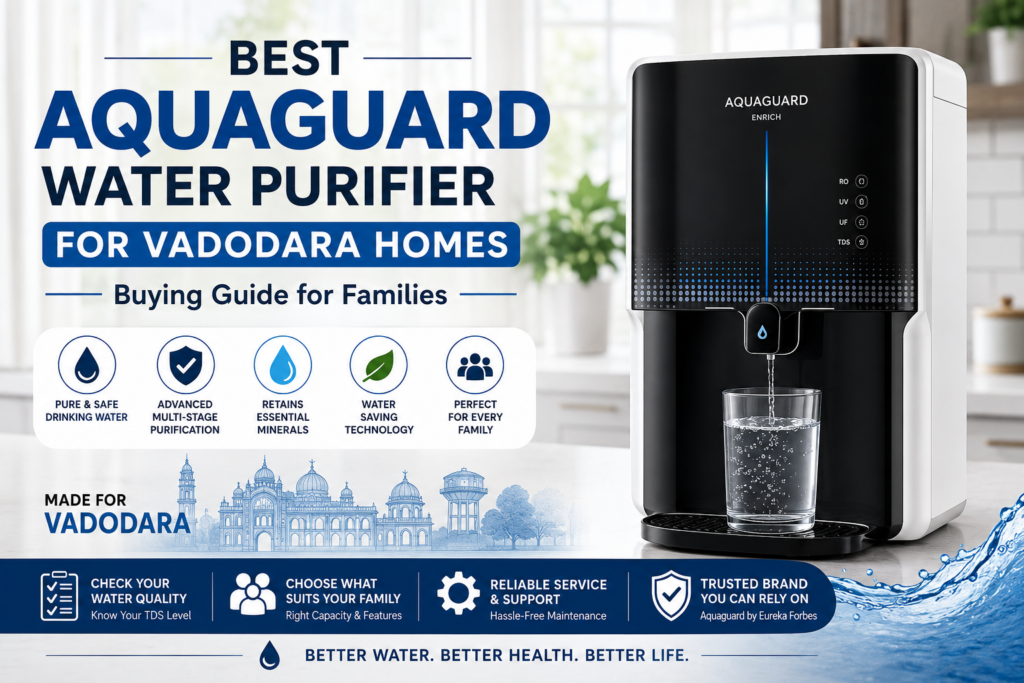
Choosing the best Aquaguard Water Purifier for Vadodara depends on your water source, TDS level, family size, daily consumption, storage needs, and access to reliable service. There is no single Aquaguard model that is best for every household.
For homes using borewell, tanker, or mixed-source water with high TDS, an RO-based Aquaguard purifier is usually the more suitable option after testing the water. Families receiving treated municipal water with low TDS may not always need RO. A UV or UV plus UF model may be enough when the main concern is microbial safety rather than dissolved salts.
For most Vadodara families, the buying decision should begin with three questions:
- Is the water municipal, borewell, tanker, or mixed?
- What is the measured TDS level?
- Is dependable local maintenance available?
Current Aquaguard ranges include models built around RO, UV, UF, mineral enhancement, water-saving features, and long-life filters. Examples seen in recent product listings include Aquaguard Sure Delight NXT, Aquaguard Delight NXT Aquasaver, and Aquaguard Enrich Aura 2X Aquasaver. Product names, technologies, warranties, and availability can change, so families should confirm final specifications through the manufacturer or an authorised local provider before purchasing.
This guide explains which type of Aquaguard purifier may suit different Vadodara homes, how to compare models, and which features are genuinely useful.
Which Aquaguard Water Purifier Is Best for Vadodara?
The best choice depends more on the water than on the purifier’s appearance or number of filtration stages.
| Household situation | Suitable purifier type | Main reason |
| High-TDS borewell water | RO plus UV or RO plus UV plus UF | Helps reduce dissolved salts and supports microbial treatment |
| Tanker and mixed-source water | RO-based multi-stage purifier | Water quality may vary between supplies |
| Low-TDS municipal water | UV or UV plus UF | RO may not be necessary when dissolved solids are already low |
| Large family | Purifier with higher storage and flow rate | Reduces waiting during peak use |
| Frequent source changes | RO model with adaptable purification | Better suited to changing TDS conditions |
| Family seeking lower reject-water waste | Aquasaver or high-recovery model | Designed to improve water recovery |
| Home with limited kitchen space | Compact wall-mounted model | Easier installation in smaller kitchens |
Do not make the final choice from this table alone. Test the water and review the exact model specifications before buying.
Why Does Vadodara Water Source Matter?
Vadodara households may receive water from municipal pipelines, borewells, private tankers, society storage tanks, or a mix of these sources.
Each source can create different concerns.
Municipal water
Municipal water usually receives treatment before distribution. However, water quality at the tap may still depend on pipeline condition, storage tanks, supply interruptions, and the building’s internal plumbing.
A home receiving stable, low-TDS municipal water may need UV, UF, carbon filtration, or a combination of these technologies rather than RO.
Borewell water
Borewell water often contains more dissolved minerals. It may taste salty, leave deposits on vessels, or show a higher TDS reading.
RO purification can help reduce dissolved salts, but TDS alone does not confirm whether water is safe. Laboratory testing may also be needed for fluoride, nitrate, iron, hardness, and microbial contamination.
Tanker water
The quality of tanker water can vary because the source may change. This makes water testing and regular purifier maintenance more important.
Families that receive tanker water frequently may prefer an RO-based purifier with sediment, carbon, membrane, and disinfection stages.
Mixed water supply
Many apartment societies shift between municipal, borewell, and tanker water. A purifier selected for only one source may not perform well when the source changes.
In this situation, ask the provider whether the recommended model can handle the full expected TDS range.
What Does TDS Mean When Buying a Purifier?
TDS stands for Total Dissolved Solids. It represents dissolved substances in water, including minerals and salts.
A TDS meter can provide a quick reading, but it cannot detect every health-related contaminant. It does not tell you whether bacteria, viruses, pesticides, or specific heavy metals are present.
The Bureau of Indian Standards publishes drinking-water specifications under IS 10500. These standards consider multiple physical, chemical, and microbiological parameters, not TDS alone.
Use TDS as one part of the decision process:
| TDS reading | General buying consideration |
| Below 200 ppm | RO may not be necessary unless testing identifies another concern |
| 200 to 500 ppm | Review taste, source, hardness, and full water-test results |
| Above 500 ppm | RO may be appropriate after professional assessment |
| Highly variable | Consider source changes and choose a model suited to the highest expected range |
These are practical buying ranges, not medical or regulatory conclusions.
Which Aquaguard Models Should Families Compare?
The Aquaguard range changes over time. Instead of declaring one permanent winner, compare models by household need.
Aquaguard Sure Delight NXT
The Sure Delight NXT range is often positioned as an accessible option for families seeking multi-stage purification without moving into the highest price category.
It may suit:
- Small or medium-sized families
- Homes with moderate daily drinking-water use
- Buyers who want essential RO and UV purification
- Households focused on value and service access
Before purchasing, confirm whether the exact version includes RO, UV, UF, mineral adjustment, or storage features. Similar product names may have different configurations.
Aquaguard Delight NXT Aquasaver
The Delight NXT Aquasaver range is worth comparing when reject-water reduction is an important concern.
It may suit:
- Homes using borewell or mixed-source water
- Families concerned about RO water wastage
- Medium-sized households
- Buyers looking for multi-stage purification
A recent marketplace comparison described the Delight NXT Aquasaver as a nine-stage water-saving purifier. Verify the current model’s recovery rate, storage, filter life, and input-water limits before selecting it.
Aquaguard Enrich Aura 2X Aquasaver
The Enrich Aura 2X Aquasaver may appeal to buyers looking for a more feature-rich purifier, including water-saving technology and longer filter-life positioning.
It may suit:
- Larger families
- Homes with higher daily use
- Buyers who value fewer routine filter replacements
- Families seeking mineral or taste-enhancement features
Eureka Forbes has promoted water purifiers with Nanopore long-life filters, including models positioned around longer filter durability. Filter life still depends on input water quality and household usage.
UV or UV plus UF Aquaguard models
Families receiving consistently low-TDS municipal water should also compare non-RO Aquaguard options.
They may suit:
- Homes with treated municipal water
- Buyers who want microbial treatment without reducing dissolved minerals
- Households that do not need an RO membrane
- Families seeking lower water rejection
A water test should guide this choice.
What Features Matter Most?
Many purifier pages use long lists of features. Focus on functions that affect daily use and long-term cost.
Purification technology
Match the technology to the water source.
- RO helps reduce dissolved salts.
- UV helps inactivate microorganisms.
- UF provides physical filtration for fine suspended matter.
- Activated carbon helps reduce chlorine, taste, and odour.
- Sediment filtration helps protect later purification stages.
More stages do not automatically mean better water. The correct stages matter more than the total number.
Storage capacity
A purifier with six to eight litres of storage may suit many small families. Larger households may need more capacity or a faster purification rate.
Consider morning routines, school schedules, cooking, guests, and power cuts.
Purification rate
Check how many litres the purifier can process per hour. A low flow rate can become inconvenient for a large family even when the storage tank looks adequate.
Water recovery
Traditional RO systems release some reject water. A high-recovery or Aquasaver model may reduce this waste, although actual recovery depends on water pressure, TDS, temperature, membrane condition, and maintenance.
Do not use reject water for drinking. It may be reused for suitable non-consumption purposes, such as cleaning floors, when the quality is appropriate.
Filter life
Long-life filters may reduce replacement frequency, but no filter lasts the same amount of time in every home.
High sediment, hardness, iron, or TDS can shorten filter life.
Indicators and alerts
Useful indicators may include:
- Tank-full alert
- Filter-change alert
- Service alert
- Purification status
- Water-quality display
These features help families notice maintenance needs before performance drops.
Service network
A technically advanced purifier can become inconvenient when genuine parts or qualified service are difficult to obtain.
Confirm:
- Installation support
- Service response in your Vadodara area
- Filter and membrane availability
- Warranty terms
- Annual maintenance options
- Cost of major consumables
How Should Different Families Choose?
A family of three using municipal water
Suppose a family in Gotri receives treated municipal water with a stable low TDS reading. They may not need RO.
A UV plus UF Aquaguard model could be a more suitable choice if water testing confirms that dissolved contaminants are not a concern.
A family of five using borewell water
A family using borewell water notices a salty taste and white deposits in the kettle. Testing shows elevated TDS.
They should compare an RO plus UV purifier with sufficient storage, good recovery, and dependable local service.
An apartment using mixed water sources
A society uses municipal water on some days and tanker water during shortages. The TDS changes often.
The household should choose a model that can handle this variation and should retest the water when the main source changes.
A home with hard water throughout the property
An under-sink or kitchen RO purifier treats drinking water only. It does not solve hard-water scaling across bathrooms, geysers, washing machines, and plumbing.
The home may need both:
- An RO purifier for drinking and cooking
- A separate water softener for utility water
Aqua Tatva offers water purifiers as part of a wider range of residential water solutions, including water softening and filtration support.
What Common Buying Mistakes Should You Avoid?
Buying without testing the water
A salesperson cannot identify every water problem from taste or appearance. Request a proper test when the source is uncertain.
Choosing the purifier with the most stages
A nine-stage system is not always better than a six-stage system. Some stages may focus on taste or mineral adjustment rather than contaminant removal.
Ignoring annual costs
Ask for likely costs for:
- Sediment filters
- Carbon filters
- RO membrane
- UV lamp
- Service visits
- Annual maintenance plan
The purchase price is only one part of ownership.
Treating TDS as a safety score
Low TDS does not guarantee microbiological safety. High TDS does not automatically mean every dissolved mineral is harmful.
Use a broader water analysis when there are health, taste, or contamination concerns.
Buying from an unverified seller
Check the seller’s authorisation, warranty process, invoice, installation terms, and service support.
Delaying filter replacement
A purifier cannot provide consistent performance when filters are clogged or overdue for replacement.
How Often Should an Aquaguard Purifier Be Serviced?
Service frequency depends on water quality, consumption, model design, and manufacturer guidance.
A practical routine includes:
- Checking taste, odour, and flow regularly
- Cleaning the external unit and tap
- Replacing filters according to alerts or service guidance
- Inspecting the membrane when TDS reduction changes
- Cleaning the storage tank as recommended
- Booking service if the purifier remains unused for a long period
Do not wait for the water to taste bad before arranging service.
Is an Aquaguard Water Purifier Worth Buying?
An Aquaguard purifier may be a good choice when the selected model matches the source water, and local service is reliable.
Potential advantages include:
- Multiple purification combinations
- RO, UV, UF, and water-saving options
- Models for different family sizes
- Established service and consumable ecosystem
- Options with mineral or taste-enhancement features
Possible limitations include:
- Recurring filter and service costs
- Reject water from RO models
- Feature differences between similar model names
- Unnecessary RO use in some low-TDS homes
- Performance dependence on maintenance
The right question is not, “Which Aquaguard is the most expensive?” It is, “Which model fits our tested water, family usage, and service expectations?”
Quick Buying Checklist
Before finalising a purifier, confirm:
- Water source
- TDS reading
- Laboratory test results when needed
- RO requirement
- UV or UF requirement
- Family size
- Storage capacity
- Purification rate
- Recovery rate
- Filter-life conditions
- Annual maintenance cost
- Warranty coverage
- Installation requirements
- Vadodara service availability
- Seller authorisation
Frequently Asked Questions
Which Aquaguard purifier is best for borewell water?
An RO-based Aquaguard purifier with UV or UF support is commonly suitable for borewell water with high TDS. Test the water first because fluoride, nitrate, iron, hardness, and microbial concerns may require specific treatment.
Is Aquaguard Sure Delight NXT suitable for a family?
It may suit a small or medium-sized family seeking essential multi-stage purification. Check the exact model’s storage, purification rate, technology, and input-TDS range before buying.
Does municipal water need an RO purifier?
Not always. When municipal water has low TDS and meets drinking-water standards, UV, UF, or carbon-based purification may be enough. Water testing provides a better answer than a general assumption.
How many litres of storage does a family need?
Many small families manage with six to eight litres. Larger families, frequent guests, or unreliable electricity may require greater storage or a faster purification rate.
How often should Aquaguard filters be changed?
The interval varies by model, water quality, and usage. Follow the manufacturer’s alerts and service guidance. High sediment or TDS may shorten filter life.
Does RO water remove all minerals?
RO reduces many dissolved substances, including some minerals. Some Aquaguard models include mineral or taste-enhancement stages. Their function and effectiveness should be checked in the official specifications.
Conclusion
The best Aquaguard purifier for a Vadodara home is the one selected after checking the water source, TDS, household use, storage requirement, maintenance cost, and local service support. High-TDS borewell or tanker water may justify an RO-based model, while low-TDS municipal water may need a simpler purification method. Compare the Sure Delight NXT, Delight NXT Aquasaver, Enrich Aura 2X Aquasaver, and suitable UV or UF options based on verified specifications rather than marketing claims.
For practical guidance, water testing, installation support, and help comparing suitable residential purification options, families can consult an authorised provider or a local water-treatment specialist. Aqua Tatva helps Vadodara homeowners assess their water source and choose a suitable water solution based on actual household needs.